LEVEL 4 / SEMESTER 1
Robert Ashley; Perfect Lives
[In Practice: use of lilting #voice, #performance, #production]
Gerald Barry
[In Practice: #vocalisation, #sounding, singing #narrative]
New Narrative Movement
[In Practice: #narrative, #space, #dissolving boundaries, #autobiography, #space]
Robert Glück defines the New Narrative Movement as writing that possesses the following characteristics;
Awareness of physical space
Metatext
Poetic strategies applied to prose
Creating works out of found material of autobiography
Gossip as legitimate art
The Production of Space
Psycho-geography of the 60’s French Situationists
Rachel Pimm

Ayesha Tan Jones
Anna Tsing/ Art of Living on a Damaged Planet
Time drawn out like taffy, twisted like hot metal, cooled hardened and splintered. In the twentieth century time is given a finite lifetime, a decay time. Moments live and die. Time like space is subject to diffraction, splitting, dispersal, entanglement. Each moment is a multiplicity within a given singularity. Time will never be the same, at least for the time being- Karen Barad Pg 106 Art Of Living On A Damaged Planet.
Landtimescapes; About Hiroshima…’the explosion is over but forever lives on. While Hibakusha in the immediate vicinity and downwind, ingest radioactive isotopes that indefinatly rework body molecules all the while manufacturing future cancers, little time bombs waiting to go off. The bomb that went off, the cascading energy of the nuclei that were split lives on and continues its explosion in the interior and exterior of bodies. The temporality of radiation exposure is not one of immediacy; rather it reworks this notion, which must then include generations before and to come.
Radioactivity inhabits time-beings and re-synchronizes and re-configures temporalities/spacetimematterings.
Radioactive decay elongates, disperses and exponentially frays time’s coherence. Time is unstable, continually leaking away from itself.
Jenna Sutela
Tai Shani
Bertolt Brecht’s Theory of Distanciation
[In Practice: #staging, #crossing dimensions, participator/creator, #connected into the art experience from the other side, #blurring boundaries ]
‘The distancing effect is a technique used in theater and cinema that prevents the audience from losing itself completely in the narrative, instead making it a conscious critical observer. The actor accomplishes this by directly addressing the audience, barring them from feeling empathy (film), interrupting the narrative (cinema), or drawing attention to the filmmaking or theatrical process. https://globalshakespeares.mit.edu/glossary/distancing-effect/
Werner Herzog; The Wild Blue Yonder
The search for the ‘ecstatic truth’
Timothy Morton; Being Ecological
Jean Genet; Fragments of the Artwork
Pasolini; Porcile
Trevor Paglen; Experimental Geography
The Secret Life of Plants. Peter Tompkins and Christopher Bird
Centre For Land Use Interpretation (CLUI)
Invasion of the Body Snatchers, Dir; Philip Kaufman 1979
The Kirlian Witness, Dir; Jonathon Sarno 1979
Dorris Lessing; The Memoirs of a Survivor
‘Periodically, the narrator is able, through meditating on a certain wall in her flat, to traverse space and time. Many of these visions are about Emily’s sad childhood under the care of her harsh mother and distant father. At the end of the novel, the main character’s strange new family breaks through dimensional barriers via the wall and walks into a much better world.’
Bruce Robbins, Prof. Humanities Columbia University.
Talks about ‘the intense fleeting experience of being embeded in a network of economic relationships from the perspective of the wealthy to the sweatshop worker.’
Daisy Hildyard; The Second Body
[In Practice: multitudes, crossing boundaries,
The dissolving of all boundaries between all life on Earth. That all human beings have two bodies – the one they have immediate autonomy over, made of flesh and bone, and another which is more diffuse.
George Elliot; Middlemarch
“If we had a keen vision and feeling of all ordinary human life, it would be like hearing the grass grow and the squirrel’s heart beat and we should die of that roar, which lies on the other side of silence.”
Climate Symphony
[In Practice: attunement, nature data, listening to nature, de-centering human, becoming #ecological, #timothy #morton, veering, #climate crisis ]
Data sonification is being used to evoke the sounds of a climate in crisis
‘Borromeo and her team at Climate Symphony, including co-director Katharine Round and composer Jamie Perera, chart this data across musical notation, working with meteorologists, conservationists, sound artists and investigative journalists. Every bar of music in Climate Symphony is equivalent to one year of scientific data – with recordings amassing a total of 20 years from 1994 to 2014. These raw data files are sonified by feeding them into a programme to sort them into notes, or by turning the data into graphs which can then be transposed onto a piano keyboard.’
https://www.wired.co.uk/article/climate-symphony-data-sonification
Margaret Atwood: Death By Landscape.
[In Practice: Art and #nature becoming one #reality #crossing #dimensions from art to nature]
A woman (Lois) recalls her time as a child spent camping over 5 summers with her friend Lucy, up until the summer Lucy vanishes without explanation. This mystery haunts Lois her whole life so much so she collects landscape paintings from the wooded scene from which her friend disappeared.
Zadie Xa; Child of Magohalmi and the Echoes of Creation (2019). Multi-media installation, Tramway Glasgow.
In Practice: Centering the #non-human animal, #storytelling, #oral #history, #onomatopoeic repetitions, #de-centering the patriarchal #ecological]
“…Xa reanimates the myth of Mago(halmi), a giant goddess who, in Korean folklore, is said to have created the world. In Xa’s hands the marginalised story of Mago is both a recuperative and speculative gesture, clamant with ecological portent…” https://artreview.com/ar-january-february-2020-review-zadie-xa/
Antoine Bertin; Edge of the Forest Yamaguchi | NTS London, 26.02.19
[In Practice: Navigating boundaries between humans/ecosystem, #sensations #beyond human #sensing and #perception, listening to nature (plant dna), #sonifying data.]
‘The Edge of the Forest weaves together field recordings and sonifications of data collected around the world.
Wandering in its own meditative way on the edge of science, technology and sound, the radio show explores where forests begin and when they end, navigating the multifaceted boundary we humans like to draw between us and our ecosystem.
From listening to the DNA of plants in Japan, to the seismic data of the Stromboli volcano or the movements of rivers in Alaska, The Edge of the Forest seeks to share sensations and ideas that inform our understanding of the natural world, humans included.‘ http://www.antoinebertin.org/nts
Cosmo Sheldrake, multi instrumentalist/composer
[In Practice: Composing music for places, performing them in those places (live in the bluebells), new audiences #shifting perspectives #non anthropocentric approach #nature #space #place]
Cosmo Sheldrake; London-based multi-instrumentalist musician, composer and producer. Live performances to places (and sometimes animals) rather than to people.
The Secret Life of Plants
[In Practice: Plants as sentient beings, #de-centering the human #other perspectives]
Documentary based on the book The Secret Life of Plants Published in 1973, ‘The Secret Life of Plants was written by Peter Tompkins and Christopher Bird, described as ” A fascinating account of the physical, emotional, and spiritual relations between plants and man.” Essentially, the subject of the book is the idea that plants may be sentient, despite their lack of a nervous system and a brain. This sentience is observed primarily through changes in the plant’s conductivity, as through a polygraph, as pioneered by Cleve Backster. The book also contains a summary of Goethe’s theory of plant metamorphosis.’ https://topdocumentaryfilms.com/the-secret-life-of-plants/
Mise en Abyme
[In Practice: into the #abyss, #picture within a picture within a picture, #mobius strip, #wormhole #infinity, #worlds within worlds, #tunnels #bridges #alternate realities #other #dimensions]

French ; ‘to put in the abyss’. Formal technique of placing a copy of an image within itself- often in a way that suggests an infinitely recurring sequence.
Film and literary theory- technique of placing a story within a story. Also in films- a dream within a dream and unconcious/virtual reality. Inception for example.
Droste effect- a picture appears within itself in a place where a similar picture would be expected to be. Based on Droste cocoa packaging from 1904, shows a woman holding a tray bake bearing Droste packaging, which bears a similar smaller version of her image.
Object Orientated Ontology. Graham Harman/ Timothy Morton
[In Practice: #reality exploring, perspective shifting, rejection of #anthropocentric ways of thinking and acting, #beyond #human #perception]
OOO (and its intertwined companion Speculative Realism) is dedicated to exploring the reality, agency, and “private lives” of nonhuman (and nonliving) entities—all of which it considers “objects”—coupled with a rejection of anthropocentric ways of thinking about and acting in the world. One of the movement’s founders, American University in Cairo philosophy professor Graham Harman, defined these objects in ArtReview as “unified realities—physical or otherwise—that cannot be reduced either downwards to their pieces or upwards to their effects.”
For OOO, your skin cells are objects, and so are you, and so is the population of the nation you live in, and so is the very idea of a nation.
The crucial point here is that, in contrast to the dominant strains of 20th-century phenomenology that claim things are only real insofar as they are sensible to a human subject, OOO asserts a radical and imaginative realism that not only claims that things do exist beyond the purview of human conception, but that this existence (defined by Harman as “nothing other than [the] confrontation of an experiencing real object with a sensual one”) is almost entirely inaccessible to our understanding.
This idea is closely linked to the OOO rejection of “correlationism,” or the habit we humans have of thinking about things only in terms of the effects they have on us. For OOO adherents, this is a tragically limited worldview that at best precludes our ability to imagine the multiverse of beings, and at worst leads directly to the wanton environmental degradation we witness today. The world according to OOO is one full of beings acting on one another according to their own goals and caprices, motivations that cannot be kenned by others. Taken from https://www.artspace.com/magazine/interviews_features/the_big_idea/a-guide-to-object-oriented-ontology-art-53690
Eduardo Navarro, Timeless Alex. 2015
[In Practice: Attuning and embodying, perspective shifting, de-centering the human perspective,…“when I was doing the performance [I felt] that it wasn’t me trying to transform, but a turtle trying to become human.” #ooo]

‘The piece featured the artist crawling into an (artificial) turtle-skin suit and chicken-wire-frame carapace before meditating in an attempt to inhabit the consciousness of the reptile he imitates. Rather than invite viewers to speculate on the lives of other creatures, Navarro makes an avowedly good-faith attempt to enter those lives himself, slowing his breathing and crawling around on all fours to complete the autohypnosis.
His self-reported identification with his subject took him to strange realms; as he’s said in an interview, “When I was doing the performance [I felt] that it wasn’t me trying to transform, but a turtle trying to become human.” ‘ Taken from https://www.artspace.com/magazine/interviews_features/the_big_idea/a-guide-to-object-oriented-ontology-art-53690
Pamela Rosenkrantz, Our Product 2015
[In Practice: beyond the realm of human perception, #ooo #graham harman #charisma.]

‘OOO artworks tend to be more interested in pointing out how objects exist, act, and “live” beyond the realm of human perception, a paradox of sorts given the contrived nature of artworks.
The artist most often associated with these ideas is Pamela Rosenkranz, the young Swiss conceptualist known for her chemically infused performances and installations. Her work Our Product from the 2015 Venice Biennale is a typical example: Rosenkranz covered the Swiss Pavilion’s floor with a mixture of various substances (including silicone, Evian water, and Viagra, among others) to create a liquid imitating “a standardized northern European skin tone.”
Combined with the computer-generated sounds of lapping water, an hormonally-enhanced green wall paint, and a smell that somehow mimicked the scent of a newborn baby, the pavilion became a subtle illustration of a central OOO idea—namely, that all objects (themselves made up of myriad other objects) exert their power over the objects around them, creating the push-pull relationship between viewer and artwork that Morton refers to as “charisma.” Taken from https://www.artspace.com/magazine/interviews_features/the_big_idea/a-guide-to-object-oriented-ontology-art-53690
Pierre Huyghe, Zoodrama. 2010
[In Practice: ideas of #OOO in vis art #Graham Harman #objects #de-centering human perspective.]

Pierre Huyghe is also cited as exemplifying some of OOO thought, with a focus on more animate objects (read: animals) the theory engages with. In works like his Zoodram series, different species of invertebrates coexist in specially designed aquaria, while his free-roaming dog Human has been repeatedly employed for Huyghe’s shows in settings from the Pompidou to LACMA. It’s hardly the first time live animals have been used as readymade actors in art, but Huyghe’s presentation seems to highlight the fact that these “objects” exist in realms inaccessible to humans—the museum’s doors close at night, but the crabs don’t seem to care. As Huyghe himself has said of his tanks, “I am interested in the strange relationship and separation between the human and a world. They are not encountering each other.” Taken from https://www.artspace.com/magazine/interviews_features/the_big_idea/a-guide-to-object-oriented-ontology-art-53690
Niels Betori Diehl, THE HEAT / scene 2 (2003)
[In Practice: Examples of Object Orientated Ontology in vis. art; turning desire into an object, decentering human experience, see #Graham Harman #OOO]

His work illustrates just how fluid the OOO conception of an object can be: Betori Diehl filmed shirtless men on a hot day from his window in Prenzlauer Berg, Berlin, taking the phrase “object of desire” quite literally.
He’s interested in how the combination of their flesh and his (or the viewers) sexual and emotional proclivities combine to form a new object: desire itself. The close-ups of glistening pecs may call pornography to mind, but although there is a similar objectification of bodies going on, the subject of the works is really the new object (desire) created by the interaction of Betori Diehl’s embodied psyche with those of his unknowing subjects. Taken from https://www.artspace.com/magazine/interviews_features/the_big_idea/a-guide-to-object-oriented-ontology-art-53690
Gregory Bateson; Steps to an Ecology of Mind. 1972
[In Practice: Being part of a whole, inter-connected nature of living. #Mobius strip, #circuit, See #Daisy Hildyard The Second Body, see #mise en abyme]
Talks about Alfred Russel Wallace’s letter to Darwin regarding his findings that coincided with Darwin’s theories on natural selection.
“The struggle for existence is like the steam engine which checks and corrects irregularities, almost before they become evident; and in like manner no unbalanced deficiency in the animal kingdom can ever reach and conspicuous magnitude, because it would make itself felt at the very first step, by rendering existence difficult and extinction almost sure to follow.”
“The steam engine is a circular train of causal events, with a link in that chain such that the more of something the less of the next thing in the circuit; a self-corrective system. Wallace had proposed the first cybernetic model.”
He believed there were 3 systems or arrangements of conservative loops. First is the human individual, second the society in which individual lives and third, the ecosystem the natural biological surroundings of these human animals. All involve an uneasy balance of dependency and competition.
“Compartmentalizing is an necessary economy; a semi-permeable linkage between consciousness and the remainder of the total mind. A limited amount of information about what’s happening in this larger part of the mind seems to be relayed to what we may call the screen of consciousness. But what gets to consciousness is selected; it is a systematic (not random) sampling of the rest.”
“TV screen does not give complete coverage or all events that occur. To report extra events would need extra circuitry and to report on this extra circuitry would require even more circuitry and so on. Each additional step towards increased consciousness will take the system further from the total consciousness.”
Wisdom- understanding of a larger interactive system, that system if disturbed is likely to generate exponential curves of change. Taken from Steps to an Ecology of Mind 1972
Henri Bergson; Creative Evolution. 1907
[In Practice: Towards the multiple.]
[…] Human intelligence, as we represent it, is not at all what Plato taught in the allegory of the cave. Its function is not to look at passing shadows nor yet to turn itself around and contemplate the glaring sun. It has something else to do. Harnessed like oxen to a heavy task, we feel the play of our muscles and joints, the weight of the plough and the resistance of the soil. To act and to know we are acting, to come into touch with reality and even live it, but only in the measure of the work which is being accomplished and the furrow that is being ploughed, such is the function of human intelligence. Yet a beneficent fluid, whence we draw the very force in which to labour and to live. From this ocean of life, in which we are immersed, we are continually drawing something, and we feel that our being or at least the intellect that guides it, has been formed therein by a kind of local concentration. Philosophy can only be an effort to dissolve again into the Whole. Intelligence reabsorbed into its principle, may thus live back again in its own genesis. But the enterprise can not be achieved in one stroke; it is necessarily collective and progressive. It consists in an interchange of impressions which, correcting and adding to each other, will end by expanding the humanity in us and make us even transcend it. […] Extract from L’Évolution créatrice (Paris: Alcan, 1907); trans, Arthur Mitchell, Creative Evolution (New York: Henry Holt & Co.,1911) 200-201
Jaques Monod; Chance and Necessity. 1970
Bergon was proponent of metaphysical vitalism (that living organisms are fundamentally different from non-living entities because they contain some non-physical element or are governed by different principles than are inanimate things.) His philosophy based on the idea of life conceived as élan, ‘a current, absolutely distinct from inanimate matter but contending with it, ‘traversing’ it so as to force it into organized form. Bergson’s kind of vitalism is one of no ultimate goal, refusing to put life’s spontaneity into any kind of predetermination’. Evolution identified with the élan vital can have neither final nor efficient causes. Man is the supreme stage at which evolution has arrived, without having sought or for seen it. He is the sign and proof of the total freedom of the creative élan.
Another Bergson fundamental: rational intelligence, an instrument of knowledge specially designed for mastering inert matter but utterly incapable of apprehending life’s inert matter. Only instinct, cosubstantial with the élan vital, can give a direct global insight into them. Every analytical and rational statement about life is therefore meaningless or irrelevant. The high development of rational intelligence in Homo sapiens has brought a grave and regrettable impoverishment of his powers of intuition, a lost treasure today we must strive to recover.
He goes on to talk about Herbert Spencer-19th C English philosopher, biologist, anthropologist, sociologist who coined term ‘survival of the fittest’, and his ideas on positivism (Positivism-philosophical theory stating that certain ‘positive’ knowledge is based on natural phenomena and their properties and relations. … Verified data ‘positive facts’ received from the senses are known as empirical evidence; positivism is based on empiricism.) His ideas on the unknown and the unknowable force which he believed operate throughout the universe creating variety, coherence, specialization and order, similar to Teilhard de Chardin’s ‘ascending’ energy- both ideas giving meaning to nature , plain animist projection giving meaning to nature so man may not be separated from it by a fathomless gulf. Taken from Jaques Monod’s Chance and Necessity. 1970.
Vladimir Vernadsky; The Biosphere. 1926
[In Practice : Moving away from individualism towards pluralism.]
[…] Life presents an indivisible and indissoluble whole, in which all parts are interconnected- both among themselves and with the inert medium of the biosphere. […] extract from Biosfera (Leningrad, 1926); trans. D.B Langmuir, The Biosphere (New York: Copernicus/Springer Verlag, 1998) 148-9.
—————————————————————————————————————————–
LEVEL 3/ SEMESTER 2
Film_Little Otik; Jan Švankmajer

An infertile couple see babies everywhere, imagining them being served up in the market out of a barrel like fish. Their comings and goings are observed through the banisters by a voyeuristic child who lives a floor above. Whilst working in the garden the husband Karel digs up a gnarled tree root and believing it looks vaguely like a baby, takes it home to his wife Božena for her amusement. This is no ordinary tree stump, after faking a pregnancy Božena ‘gives birth’ to baby Otik who comes alive. Otik has an insatiable appetite and requires more and more food until the fateful day he decides to take his huger into his own hands. Of particular interest_ #anthropomorphizing #nature, fairy tale darkness, live action and #stop motion animation used together, the grizzly, visceral, funny, grotesque feel and aesthetic.
Notes from _The Gender of Sound_Anne Carson
We judge people on their voices, whether they’re sane/insane, male/female, good/evil, trustworthy/depressive, marriagable/morribund. Likely or unlikely to make war on us. Aristotle tells us- high pitched voice of the female is one evidence of her evil disposition. Creatures who are brave and just (like lions, bulls, roosters- the human male) have large deep voices. High vocal pitch- talkativeness to characterize a person who is deviant from or deficient in the masculine ideal of self control. Women, catamites, eunuchs and androgynes- all in this category. Their sounds are bad to hear and make men uncomfortable. Aristotle- ascribing the lower pitch of male voices to the tension placed on a mans vocal chords by his testicles functioning as loom weights. Helenistic and Roman times- doctors recommended vocal exercises to cure all sorts of physical ailments on the theory that the practise of declamation would relieve congestion in the head and correct the damage men do to themselves by using their voice for high pitched sounds, loud shouting or aimless conversation. Of particular interest_how the sound of ones #voice can say so much about who we are, or who others believe we are. Use the voice, experiment with voice and sounds, what effect does this have?
Kurt Schwitters_Ursonate
Early example of sound poetry. Of particular interest_ using sounds rather than words to create rhythms and structure, vocalizations, experimenting with different mouth shapes
Gertrude Stein_ Tender Buttons
A CARAFE, THAT IS A BLIND GLASS.
A kind in glass and a cousin, a spectacle and nothing strange a single hurt color and an arrangement in a system to pointing. All this and not ordinary, not unordered in not resembling. The difference is spreading.
A METHOD OF A CLOAK.
A single climb to a line, a straight exchange to a cane, a desperate adventure and courage and a clock, all this which is a system, which has feeling, which has resignation and success, all makes an attractive black silver.
Ludwig Wittgenstein observed, “that a poem, even though it is composed in the language of information, is not used in the language-game of giving information.” Stein’s poems illustrate this aphorism at every turn: she takes ordinary language—the “language of information”— and makes it strange, forcing us to be acutely aware of the way words work. Taken from http://www.poets.org Of Particular interest_ making the mundane and everyday unfamiliar and strange, redefining and undermining meaning, playing with word sounds and structure.
Dennis Potter_Blue Remembered Hills // Pennies From Heaven

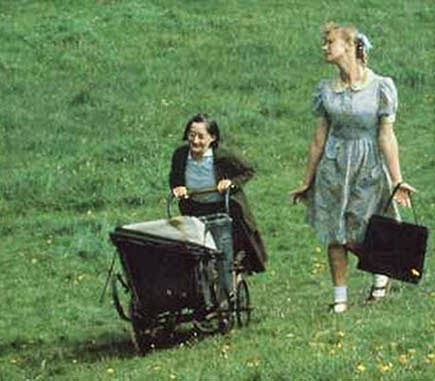
Into my heart an air that kills From yon far country blows: What are those blue remembered hills, What spires, what farms are those? That is the land of lost content, I see it shining plain, The happy highways where I went
And cannot come again. -A E Housman
Adults are cast in the roles of seven year old children who we see whiling away an afternoon playing together in the Forest of Dean. Set in the summer holidays of 1943, the boys play commandos their games affected by the ongoing war and the girls play house together in the barn whilst teasing and tormenting a shy outcast boy. The girls go off to join the boys leaving him alone, their play eventually culminating in a devastating event. Of particular interest_ the uncanny nature of adults playing children, otherness, disruption of perception, distorted memories, subversion of a supposed innocence
Pennies From Heaven, a musical drama serial from 1978 used the romantic songs of the Thirties to counterpoint the daily grind of life during the Great Depression. Characters living the grim realities of everyday drudgery suddenly brake out into a musical number. Of particular interest_ the uncanny nature of running the everyday and the fantastical in parallel, the lip-synching to songs, the use of voices, reality and fiction
The Ouroboros_ Snakes as symbols

The image of a snake eating its own tail, representing eternity, the continual renewal of life.
Snakes as symbols of change re-birth and transformation, the umbilical cord that joins all humans with Mother Earth.
Snakes as totem animals and the dualism of good and evil.
Snakes can open chakras, represent Kundalini energy, the coiled serpent according to kundalini yoga is where creativity and emotions are seated.
Of particular interest_ Snakes as symbols of change, slithering and visceral, as lightening bolt/phallus, polarizing creatures, highly charged entities, as shared spirit
Ian Breakwell’s Diary
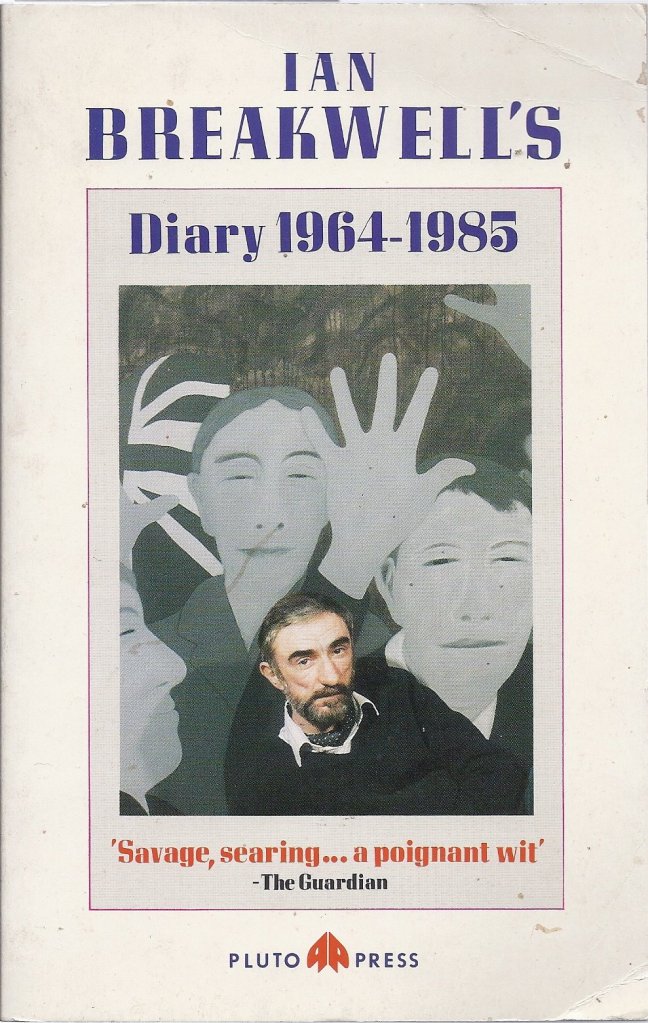

Ian Breakwell’s observations of everyday life. Of particular interest_ describing the mudanities of life, use of humour, communicating personal insights, real life, documentation, writing style
The Hero of a Thousand Faces_Joseph Campbell
“In his study of world hero myths Campbell discovered that they are all basically the same story –retold endlessly in infinite variations. He found that all story-telling, consciously or not, follows the ancient patterns of myth, and that all stories, from the crudest jokes to the highest flights of literature, can be understood in terms of the hero myth; the “monomyth” whose principles he lays out in the book” http://www.thinking-differently.com/creativity/wp-content/uploads/2014/01/The-Heros-Journey.pdf
Step 4 in Campbell’s theory is ‘the meeting with the mentor’; the hero is encouraged by the Wise Old Man or Woman. The mentor gives advice and sometimes magical weapons. This is Obi Wan giving Luke his father’s light saber. The mentor can go so far with the hero. Eventually the hero must face the unknown by himself. Sometimes the Wise Old Man/Woman is required to give the hero a push to get the adventure going. Of particular interest_ the opposition of mentor and mentee, the student and teacher, bringing life to differing aspects of ones character, the parallels to Jung’s archetypes; constantly repeating characters who occur in the dreams of all people and the myths of all cultures.
Watership Down_Richard Adams
“Animals don’t behave like men,’ he said. ‘If they have to fight, they fight; and if they have to kill they kill. But they don’t sit down and set their wits to work to devise ways of spoiling other creatures’ lives and hurting them. They have dignity and animality.” Richard Adams_Watership Down
Of particular interst_Fiver’s apocalyptic visions, an animal’s dreams, alternate perspective, intuition
David Abram_ Becoming Animal an Earthly Cosmology
P 4—8: “Is it possible to grow a worthy cosmology by attending closely to our encounters with other creatures, and with the elemental textures and contours of our locale? We are by now so accustomed to the cult of expertise that the very notion of honoring and paying heed to our directly felt experience of things—of insects and wooden floors, of broken-down cars and bird-pecked apples and the scents rising from the soil—seems odd and somewhat misguided as a way to find out what’s worth knowing. According to assumptions long held by the civilization in which I’ve been raised, the deepest truth of things is concealed behind the appearances, in dimensions inaccessible to our senses. A thousand years ago these dimensions were viewed in spiritual terms: the sensuous world was a fallen, derivative reality that could be understood only by reference to heavenly realms hidden beyond the stars. Since the powers residing in such realms were concealed from common perception, they had to be mediated for the general populace by priests, who might intercede with those celestial agencies on our behalf.”
P. 132—134:
Each place has its rhythms of change and metamorphosis, its specific style of expanding and contracting in response to the turning seasons, and this, too, shapes—and is shaped by—the sentience of that land. Whether we speak of a broad mountain range or of a small valley within that range, at each scale there is a unique intelligence circulating among the various constituents of the place— a style evident in the way events unfold in that ecosystem, how the slow spread of a mountain’s shadow alters the insect swarms above a cool stream, or the way a forested slope rejuvenates itself after a fire. For the precise amalgam of elements that structures each region exists nowhere else. Each place, that is to say, is a unique state of mind, and the many powers that constitute and dwell within that locale—the spiders and the tree frogs no less than the humans—all participate in, and partake of, the particular mind of the place.
Of particular interest_ the wild intelligence of our bodies, taking our primary truths from technologies, holding the living world at a distance, subverting this distance, our animal senses, kinship between the human body and the Earth. ‘The shape-shifting of ravens, the erotic nature of gravity, the eloquence of thunder, the pleasures of being edible’. From Becoming Animal; an Earthly Cosmology
Luce Iragaray_Key Writings
P. 135_”Cosmic and personal waves can thus vibrate together, and likewise a field of interpersonal vibrations can be created.” Of particular interest_ as above with David Abram, seeing ourselves as one interconnected entity with the earth and all vibrations around us.
Samuel Beckett // Theatre of the Absurd
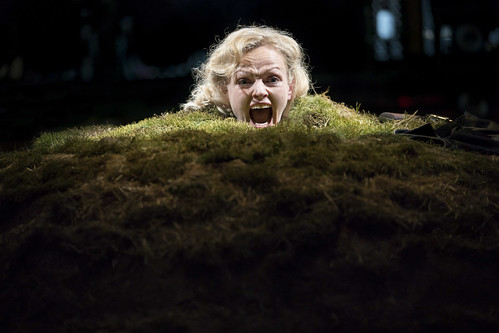
“Characterised by a fascination with absurdity in all its forms – philosophical, dramaturgical, existential, emotional – this is a drama form that pushes theatre to extremes, and which asks probing questions about what reality (and unreality) really looks like. Often interpreted as a response to the challenges of living in a 20th-century world that seems devoid of meaning, it is frequently far more nightmarish than funny.” https://www.bl.uk/20th-century-literature/articles/nonsense-talk-theatre-of-the-absurd
“Characters are often caught up in repetition, a key feature of Beckett’s writing at a syntactical and structural level, representing the deadening impact of habit, the recurrence of trauma, or the recourse to familiar and reassuring words or phrases in the face of annihilation.”
Of Particular interest_ Sarah Frankom’s production of Happy Days at Royal Exchange;Manchester, retuned for an age of ecological anxiety, woman trapped in pile of waste of her own creation, existential crisis of the self- now existential crisis of the species.
Unheimlich_Freud’s Uncanny
Sigmund Freud’s essay The Uncanny (1919) repositioned the idea as the instance when something can be familiar and yet alien at the same time. He suggested that ‘unheimlich’ was specifically in opposition to ‘heimlich’, which can mean homely and familiar but also secret and concealed or private. ‘Unheimlich’ therefore was not just unknown, but also, he argued, bringing out something that was hidden or repressed. He called it ‘that class of frightening which leads back to what is known of old and long familiar.’
The term ‘uncanny valley’ is also applied to artworks and animation or video games that that reproduce places and people so closely that they create a similar eerie feeling.
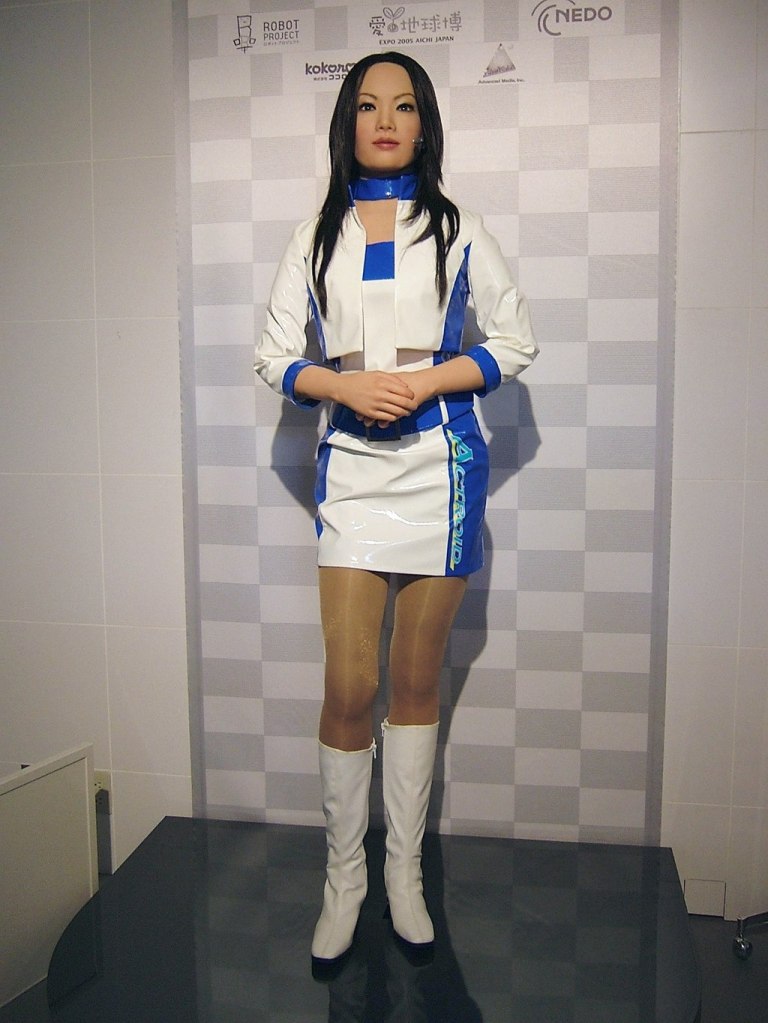
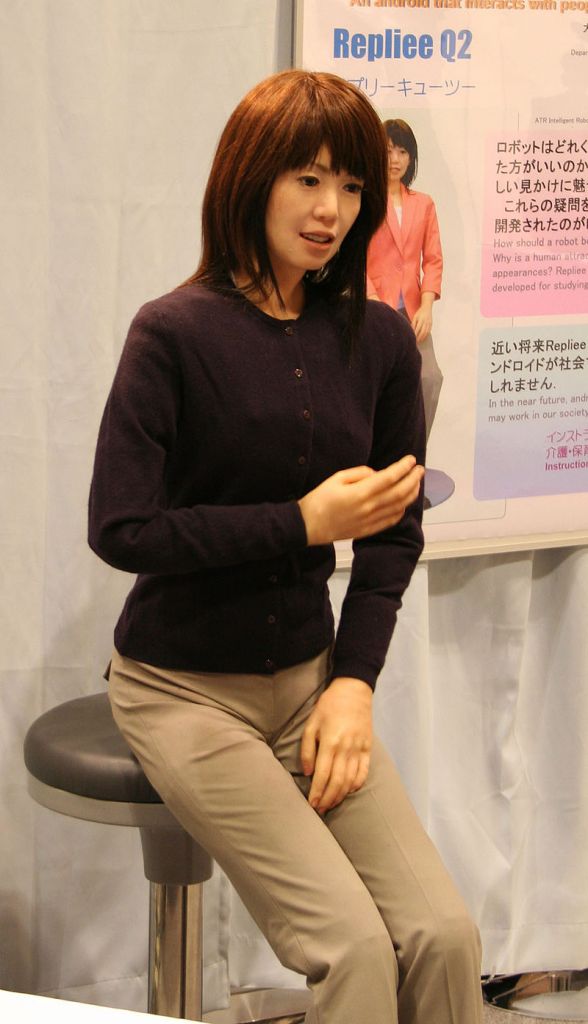
Of particular interest_ sounds, mouthing words, lip-synching, otherness, alternative reality, oppositional truths, unexpected voices, characterization, creating atmosphere, sense of unknown
Siphonophores
Deep sea predators made up of many small clones that act together as one and spread out like a single long string in the water.
“The creature isn’t, strictly speaking, one animal. Instead, it’s a genus of siphonophore called Apolemia, every individual siphonophore is made up of many little “zooids,” which each live lives that are more similar to animals we’re used to talking about, albeit always connected to the larger colony. Zooids are born axsexually, and each one performs a function for the siphonophore’s larger body, according to a research article published in the journal Developmental Dynamics in 2005. Linked together in long chains, the colonies were already known to reach lengths of up to 130 feet (40 m) https://www.ecowatch.com/worlds-longest-animal-ocean-2645712197.html?rebelltitem=4#rebelltitem4 Of particular interest_ the ‘individual’ becoming a multiple, relating to ideas of Donna Harraway
Derek Bailey_On the Edge
“What makes On the Edge so timeless is the notion that improvised music shares a community — everything from a Lebanese organist living in Paris (Naji Hakim) to qawwali from the Sufis in New Delhi to Chicago trombone/video-manipulation via George Lewis — a cross-pollinated sonic world based on spontaneous interaction.” https://www.npr.org/sections/ablogsupreme/2009/05/reissue_this_now_derek_baileys_1.html?t=1587042692988 Of particular interest_ improvisation, responding to sounds/sounds of others, how does this transcribe in to nature, eschewing conventional notions of melody and rhythm.
Hanna Tuulikki
“Artist, composer and performer based in Scotland, who specialises in working with the voice and gesture, to re-imagine resonant stories of contemporary relevance. In research-led, multi-disciplinary projects, she investigates the ways in which the body communicates beyond and before words. With a particular interest in the practice of ‘mimesis’ within musical and movement traditions across cultures, her work explores the place of folk narratives, memory, ritual and technology within specific environments. Informed by contemporary understandings of ‘naturecultures’ and ‘gender performance’, her work gravitates towards the spaces ‘in-between’, be it human-and-more-than-human, male-and-female, or ancient-and-contemporary, considering the ‘sounding body’ as a meeting point between self and the world.” https://www.hannatuulikki.org/about/ Of particular interest_ ‘using the voice to create emersive spaces in an attempt to unearth an essential relationship with the lore of places’, mimesis or imitation of nature.
‘Mnemonic topographies; The land encoded in the song. The lore embedded in the land‘
Taken from her talk on ‘Away with the Birds’.
Nausicaä of the Valley of the Wind
“Nausicaä of the Valley of the Wind was born. The post-apocalyptic series takes place a thousand years after the Seven Days of Fire, a cataclysmic global war that destroyed most of the world. The world is polluted with toxic air and the seas are poisonous. The remaining humans live in small pockets of non-polluted land outside of the Corrupted Sea, a deadly human-made forest inhabited by massive mutant insects that protect it, as the forest rids the world of pollution. The remaining humans have divided themselves into warring kingdoms that fight over limited resources as the Corrupted Sea threatens to consume them all.” https://filmschoolrejects.com/nausicaa-of-the-valley-of-the-wind/
As inspired by the 12th century Japanese tale ‘The Lady Who Loved Insects,by 虫めづる姫君, Mushi-mezuru Himegimi) the story of a princess who preferred to befriend insects to beaus and also themes in the work of Ursula Le Guin. Of particular interest_ ideas of nature first human second, being another small part of the biodiversity on the planet
Andrea Dunbar/ Clio Barnard_The Arbor
A film based of the life and work of Andrea Dunbar combining real accounts with aspects dramatization.
In The Arbor, “Clio Barnard creates a transitional world between fact and fiction – highlighting the struggles of social depravation, aggressive racism, and powerful addictions through the prism of the flexibility of memories and the ever-ambiguous nature of reality..Barnard spent two years recording interviews with the Dunbars and residents of Buttershaw to collect an extensive archive on Andrea, her world and her legacy. These recordings form the basis of the film, as actors take on not only the words of the real-life characters, but also the voice, intonation, emphases and pauses in an exciting collaboration between fact and fiction. Borrowing from verbatim theatre, The Arbor manipulates reality further by creating private moments with the character, through the face of the actor.”
Of particular interest_The lip-synching actors bring life to the often harrowing accounts, a scene of the play The Arbor is performed on the estate with the real life inhabitants looking on from their door steps. Reality and non reality collide.
Donna Harraway- Cyborg Manifesto
The Shape of a Circle in the Mind of a Fish Symposium. Serpentine London 2018
 L E N_G O E T Z E E